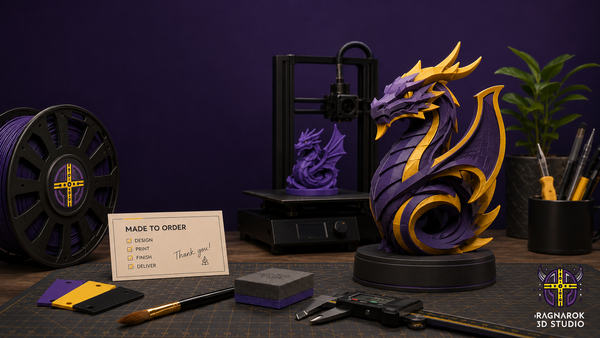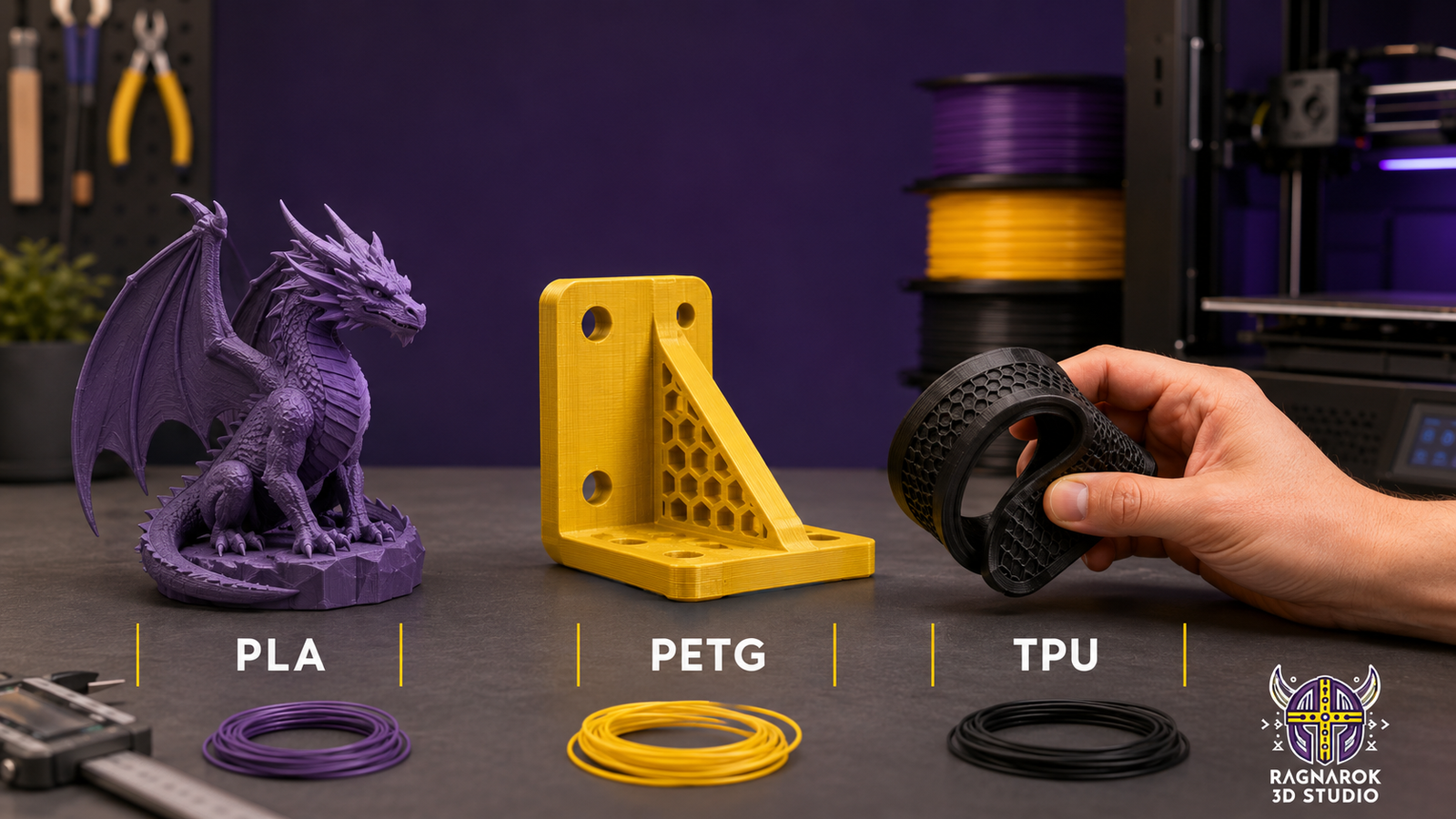

Not all 3D printed products are made from the same material. Learn the difference between PLA, PETG, and TPU, and why the right material matters for custom prints, display pieces, flexible items, and everyday-use products.
The Difference Between PLA, PETG, and TPU for 3D Printed Products
A customer will often come to us with an idea and ask, “Can this be 3D printed?”
Most of the time, the answer is yes. But the better question is: what material should it be printed with?
Not every 3D printed product needs to be made the same way. A display dragon, a sport chain, a flexible part, a hand painted miniature, and an outdoor-use sign all have different needs. Some need crisp detail. Some need strength. Some need flexibility. Some need to look great on a shelf. Others need to handle regular use.
That is where material choice matters.
At Ragnarok 3D Studio, we work with different 3D printing materials depending on the product, the purpose, and the finish the customer wants. Three of the most common materials people hear about are PLA, PETG, and TPU.
Here is a practical guide to what they are, how they are different, and why we may research and recommend one material over another for your custom 3D printed project.
Why 3D Printing Material Matters
When someone orders a custom print, it can be tempting to think only about the design.
The design is important, but the material affects:
- Strength
- Flexibility
- Detail
- Surface finish
- Paintability
- Heat resistance
- Outdoor durability
- How the product feels in your hand
- How the product holds up over time
A good 3D printed product starts with matching the material to the job.
That is part of the craft. Forged in Design. Printed in Precision.
PLA: The Clean, Detailed, Everyday Favorite
PLA is one of the most common 3D printing materials, and for good reason. It prints cleanly, holds detail well, and works great for many decorative, display, and light-use products.
What PLA Is Best For
PLA is often a strong choice for:
- Display pieces
- Dragons
- Miniatures
- RPG accessories
- Decorative signs
- Keychains
- Paintable 3D prints
- Hand painted 3D prints
- Custom gifts
- Shelf-ready products
- School craft projects and group craft ideas
PLA is usually the material we think about first when the goal is clean detail and a nice visual finish.
If you are looking for a 3d Printed hand painted piece, PLA is often a great fit because it can hold crisp surface detail and takes finishing work well when properly prepared.
Why Customers Like PLA
PLA has a clean, consistent look. It works well for colorful prints, display items, and products where the shape and detail matter most.
For example, a dragon figure, tabletop accessory, miniature display piece, or paintable project does not usually need to flex. It needs to look sharp, print cleanly, and feel well-made.
That is where PLA shines.
PLA Limitations
PLA is not the best choice for every situation.
It can soften if exposed to higher heat, such as inside a hot vehicle during summer. It is also not the best material for parts that need to bend, flex, or handle heavy mechanical stress.
PLA is strong enough for many normal products, but it is not always the best fit for outdoor, high-heat, or impact-heavy use.
PETG: The Durable Middle Ground
PETG is a tougher material that sits between PLA and more industrial-use plastics. It is often chosen when a product needs more durability, better temperature resistance, or improved toughness.
What PETG Is Best For
PETG can be a strong option for:
- Functional custom 3D printed projects
- Outdoor-friendly parts
- Utility pieces
- Practical brackets or holders
- Signs that may see more handling
- Products that need more toughness than PLA
- Items that may be exposed to moisture
- Everyday-use prints
PETG is not always as crisp-looking as PLA, but it brings useful strength and durability.
Why We May Recommend PETG
If a customer brings us a design that will be handled often, placed in a garage, used around equipment, or exposed to more real-world wear, PETG may be a better choice than PLA.
For example, a custom holder, utility part, outdoor label, or functional print may benefit from PETG’s toughness.
It is a practical material when the product needs to do more than sit on a shelf.
PETG Limitations
PETG can be more challenging to print cleanly than PLA. It may show more stringing or have a slightly different surface finish. It is also not flexible like TPU.
For highly detailed decorative pieces, PLA may still be the better choice. For flexible parts, TPU is usually the better direction.
TPU: The Flexible Material
TPU is different from PLA and PETG because it is flexible. It can bend, compress, and return to shape depending on the design and print settings.
What TPU Is Best For
TPU can work well for:
- Flexible grips
- Bumpers
- Protective feet
- Soft-touch parts
- Gasket-style pieces
- Flexible accessories
- Rubber-like custom pieces
- Products that need bend instead of rigidity
TPU is a good example of why material choice matters. A product that would fail if printed rigid may work well when printed in a flexible material.
Why TPU Is Useful
Some products need give.
A rigid plastic bumper may crack or feel too hard. A TPU version can absorb more movement. A grip made from PLA may feel slick or uncomfortable. A TPU grip can feel softer and more practical.
TPU opens up possibilities that rigid materials cannot handle as well.
TPU Limitations
TPU is not the right fit for everything.
It can be slower to print. It may not capture sharp decorative detail the same way PLA does. It can also be more expensive and more limited in color or finish options depending on the project.
For detailed display pieces, PLA is usually better. For durable rigid parts, PETG may be better. For flexible parts, TPU is the material to consider.
PLA vs PETG vs TPU: Simple Comparison
PLA
Best for clean detail, display pieces, paintable prints, miniatures, dragons, RPG accessories, custom gifts, and hand painted 3D prints.
PETG
Best for tougher, more practical products that need durability, moisture resistance, or more real-world use.
TPU
Best for flexible parts that need to bend, compress, grip, cushion, or absorb movement.
Which Material Is Best for Hand Painted 3D Prints?
For most hand painted 3D prints, PLA is usually the best starting point.
That is because PLA can produce clean detail, smooth surfaces, and crisp shapes that work well for finishing and painting. Miniatures, dragons, RPG accessories, seasonal pieces, signs, and decorative models are often strong candidates for PLA.
Good results still depend on the design, print settings, surface prep, primer, and paint. But when a customer asks for a 3d Printed hand painted product, PLA is often the material we research and recommend first.
PETG can be painted too, but it may not always be the first choice for fine decorative detail. TPU can also be painted in some cases, but flexible materials need special consideration because paint can crack if the part bends.
Matching Material to Product Type
Different products call for different materials.
Dragons and Miniatures
For dragons, miniatures, and display pieces, PLA is usually a great fit. It captures detail well and works nicely for shelf-ready products or paintable 3D prints.
RPG Accessories
Dice towers, condition markers, terrain-style pieces, and tabletop accessories often work well in PLA because detail and finish matter. Some utility-style RPG accessories may benefit from PETG depending on use.
Sport Chains
Sport chains are usually designed to be bold, lightweight, and wearable for school spirit, tournaments, senior nights, or community events. Material choice depends on the chain design, color needs, and how the product will be used.
Custom Prints
For custom 3D printed projects, material choice depends on the purpose. A decorative sign may be PLA. A functional holder may be PETG. A flexible part may be TPU.
Licensed Prints
Licensed prints depend on the creator’s model, the intended use, and the best material for the finished product.
When referencing licensed work, we use careful wording:
Printed by Ragnarok. Licensed creator design. Crafted with permission.
Suggested internal link: Licensed Collections
How We Choose the Right Material
When someone brings us an idea, we do not just look at whether it can be printed. We look at how it will be used.
We may ask:
- Will it be decorative or functional?
- Will it be handled often?
- Does it need to bend?
- Will it be used indoors or outdoors?
- Does it need to be painted?
- Does it need fine detail?
- Will it be exposed to heat, moisture, or impact?
- Is the final look more important than the mechanical strength?
Those answers help us research and recommend the right material.
That is the difference between simply printing a file and making a finished product with purpose.
A Practical Takeaway
PLA, PETG, and TPU each have a place.
PLA is great for clean detail, display pieces, paintable items, and many everyday 3D printed products. PETG is a better fit when toughness and durability matter. TPU is the choice when flexibility is the point of the design.
The best material is not always the strongest one. It is the one that fits the product, the customer, and the way the item will actually be used.
At Ragnarok 3D Studio, we help customers choose the right path before the print begins. That is how we keep the work clean, useful, and made with care.
Modern Craft. Viking Spirit.
Have a custom idea, product request, or project you want to talk through?
Bring us your design and we’ll make it real.
Ready to add it to your collection?
Printed to order · Ships in 3–7 business days